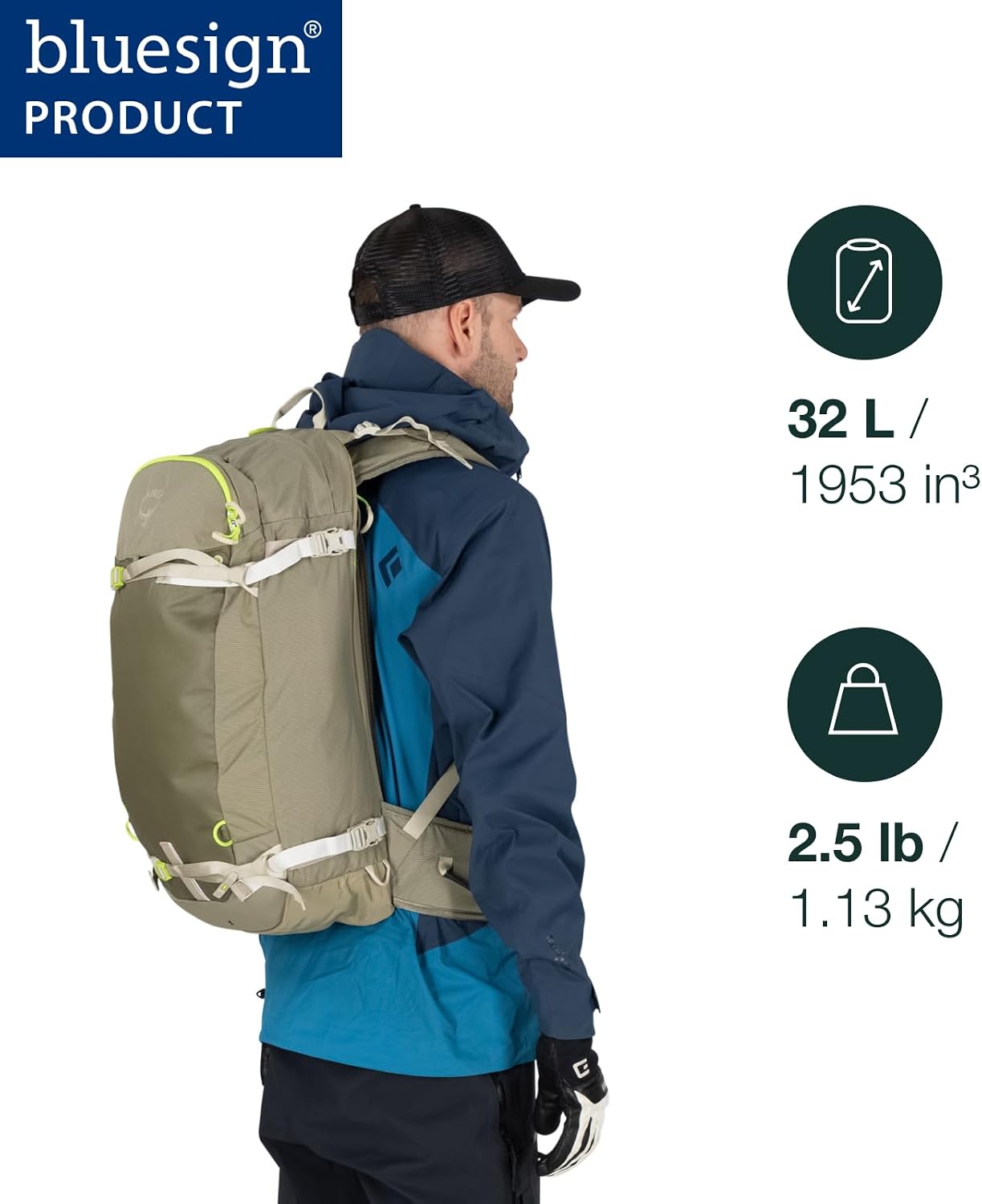
If you’ve ever watched a ski touring pack recommendation thread devolve into a liter debate — “22L is plenty,” “no, you need 32L minimum” — you already know the core problem: volume (how many liters a pack holds) is a proxy for an entirely different conversation about what kind of day you’re actually planning. A liter, for context, is roughly the space taken up by a standard water bottle. Most ski touring packs run from about 18L (a streamlined day pack) up to 40L+ (a multi-day or hut-trip hauler). Ski touring itself means earning your turns under human power — skins on the skis, climbing up before skiing down — rather than riding a lift. The pack is your life support system: water, safety gear, layers, fuel, and any avalanche rescue equipment you’re carrying. Get the volume wrong in either direction and the day suffers. This guide gives you the decision framework to match the right pack size to the right use case — useful whether you’re buying for yourself or gifting to someone whose mountain days you know well.
Why Liters Matter More Than Features on the Tag
The outdoor industry does a good job of adding features to justify price points. Helmet carries, back-panel organization, dedicated hydration sleeves, ski-carry systems — every pack above $150 has most of them. What the feature list can’t tell you is whether the total volume fits the day being planned.
REI Co-op’s ski pack buying guide frames it cleanly: the volume you need is almost entirely a function of trip duration and safety gear requirements, not personal preference. A resort-adjacent skier doing short sidecountry laps (terrain accessed by hiking a short distance from a resort boundary) needs fundamentally different storage than someone running a 12-hour backcountry objective with a full three-piece avalanche safety kit — beacon (the electronic device that transmits and receives a signal to locate a buried person), shovel, and probe (the collapsible pole used to locate and excavate a buried skier).
The practical breakdown, per aggregated spec-sheet analysis across current market offerings:
By the numbers:
| Use Case | Recommended Volume | Typical Price Range |
|---|---|---|
| Sidecountry / resort day laps | 18–22L | $100–$200 |
| Full-day backcountry tour | 25–32L | $180–$320 |
| Hut trip / multi-day | 35–45L | $280–$450 |
| Airbag-equipped safety pack | 22–35L (airbag adds ~1–2L) | $400–$900 |
The numbers above reflect published manufacturer specs and current 2026 pricing across major U.S. outdoor retailers. Airbag packs — which contain an inflatable bladder designed to keep a buried skier near the snow surface in an avalanche — carry a significant price premium because of the inflation mechanism, whether that’s a canister system or the newer battery-powered electronic trigger.
The Three Decisions Inside Every Pack Purchase
1. What’s the Actual Terrain Commitment?
This is the question most gift guides skip, but it’s the one that prevents regret. Sidecountry and resort day laps are genuinely different use cases from a committed backcountry tour, and the pack should reflect that honestly.
Sidecountry / in-bounds plus short hikes (18–22L): Owners of packs in this range — models like the Osprey Kamber 22 or the Black Diamond Helio 20 — consistently report that the volume is generous enough for a full day of laps without feeling bulky on the chair or during short bootpacks (the hiking-in-ski-boots approach to a steeper section). The tradeoff is real: reviewers at GearJunkie and Outside Online both note that 20L packs get uncomfortable fast when you try to stuff a full beacon-shovel-probe kit alongside a hardshell layer, snacks, and a 2L hydration reservoir. The compartment logic starts to break down.
If the recipient is doing true sidecountry — exiting resort boundaries, triggering a meaningful avalanche terrain commitment — and they’re not carrying an airbag, 22L is the floor, not the ceiling.
Full-day backcountry (25–32L): This is where the market clusters for good reason. A 28–30L pack hits the sweet spot that backcountry-focused reviewers at Backpacker Magazine and REI’s gear team keep returning to: enough room for a complete avalanche kit, a hardshell, food and water for 6–8 hours, a repair kit, and a packable insulation layer — without adding the bulk and weight that makes the pack feel like a burden on a long skintrack. Osprey’s Soelden series, Black Diamond’s Cirque 30, and Deuter’s Freerider Pro 30 all occupy this band. Across aggregated reviews, the pattern is consistent: 28–32L is the volume where nothing has to be sacrificed for a full-day objective.
Multi-day and hut trips (35–45L): Once overnight gear enters the equation — sleeping bag, shelter, a second pair of boots or overboots for cold camps — the volume math shifts fast. REI’s learning center notes that most hut-trippers find 38–42L to be the practical ceiling before pack weight itself becomes the limiting factor on technical terrain. Above 40L, you’re fighting the pack on descents.
2. Does the Recipient Need an Airbag?
This is the decision that doubles the price and changes the entire purchase logic. Avalanche airbag packs are not universally necessary — they’re specifically valuable for skiers who regularly travel in consequential avalanche terrain (meaning terrain where a slide would likely be unsurvivable without intervention). Avalanche.org’s backcountry gear resources are direct on this: airbag packs are a supplement to — not a replacement for — beacon, shovel, and probe skills, and they don’t reduce the obligation to make good terrain decisions.
For gifting purposes, the honest framing is: if the recipient is a committed backcountry skier who already owns and trains with a beacon-shovel-probe kit, an airbag pack is a meaningful upgrade gift. If they’re earlier in their progression, the safer gift investment is a quality beacon (Black Diamond’s Guide BT or Mammut’s Barryvox are the two options reviewers consistently cite as the clearest interfaces for beginners) rather than an airbag pack.
Current airbag market leaders reviewed at GearJunkie and Outside Online:
- BCA Float 32 (electronic trigger): Owners report the battery-powered system removes the canister-refill friction that used to complicate travel with airbag packs. At 32L, it fits a full day’s kit. Street price in 2026 is running $620–$680.
- Mammut Pro X Removable 35 (compressed air): The removable airbag unit is transferable to future packs, which reviewers at Outside Online flag as a meaningful long-term value argument. The 35L volume suits hut-capable objectives.
- Osprey Soelden 32 Airbag-Ready: Worth noting for the gifter who wants to let the recipient choose their own airbag unit later — the pack is built to accept an aftermarket trigger module.
3. Ski-Carry System: Does It Match the Skis?
This is the detail that separates a thoughtful gift from one that gets returned. Ski touring packs offer two main carry methods: A-frame (skis crossed in an X on the back of the pack) and diagonal (a single ski angled across the pack face). Both systems are present on most mid-to-upper-range packs, but the execution varies in ways that matter for wider skis.
Modern all-mountain touring skis — particularly fat skis with widths above 100mm underfoot — don’t always play well with A-frame systems designed for narrower race-oriented skis. Backpacker Magazine’s pack guide notes that diagonal carry is generally more forgiving for fatter skis and more stable when scrambling or skinning on steep terrain. If the recipient skis on wide powder tools, prioritize packs where the diagonal carry is a primary system, not an afterthought.
The Gift-Framing Decision Tree
For corporate retreat organizers and lodge hosts building a gear-gift program: ski touring packs are high-utility gifts that land well precisely because most recipients have been making do with a pack that’s slightly wrong for their use case. The decision logic for gifting:
If the recipient skis primarily resort / sidecountry and doesn’t carry avalanche gear: A 20–22L pack in the $130–$200 range is the right call. It’s a genuine upgrade without the overengineering of a full backcountry rig. Osprey’s Kamber line and Dakine’s Poacher series both receive strong owner reviews in this segment.
If the recipient is a committed backcountry tourer without an airbag: A 28–32L pack at $200–$320 is the spend. This is the volume range where they can carry what they need without compromise. Black Diamond’s Cirque 30 and Osprey’s Soelden Pro 32 are the two models reviewers keep returning to as benchmark options.
If the recipient is ready for an airbag upgrade: Budget $600–$850 and go BCA Float 32 or Mammut Pro X. These are not casual gift-card territory — they’re deliberate investments that signal you understand exactly what the recipient does on weekends.
If you’re genuinely uncertain about their use case: Skip the pack and gift a beacon. A Black Diamond Guide BT or Mammut Barryvox in the $350–$450 range is more universally useful than guessing on volume, and it’s a safety item that owners consistently report having bought too late in their backcountry progression.
The One Number to Get Right
If there’s a single calibration that matters more than any other in this decision: 28–30L covers the widest range of backcountry day-use scenarios without requiring the buyer to know exactly how long or technical the recipient’s typical day is. REI’s learning center, GearJunkie’s multi-year buyer’s guide, and Outside Online’s seasonal pack roundups all converge on this band as the practical all-rounder. It’s not the most optimized choice for fast-and-light race objectives (go 18–22L for that) and it won’t handle a full hut trip without compression (go 38L+ for that) — but for the 80% of full-day backcountry use cases, it’s the volume that doesn’t make you wish you’d sized differently.
If X is a committed backcountry skier doing full-day objectives in avalanche terrain with an existing safety kit, then Y is 28–32L at $200–$320, or an airbag option at $600+ if they’re ready for that step. Everything else in the feature list — hip belt pockets, hydration routing, back-panel access — is worth caring about after the volume question is answered.