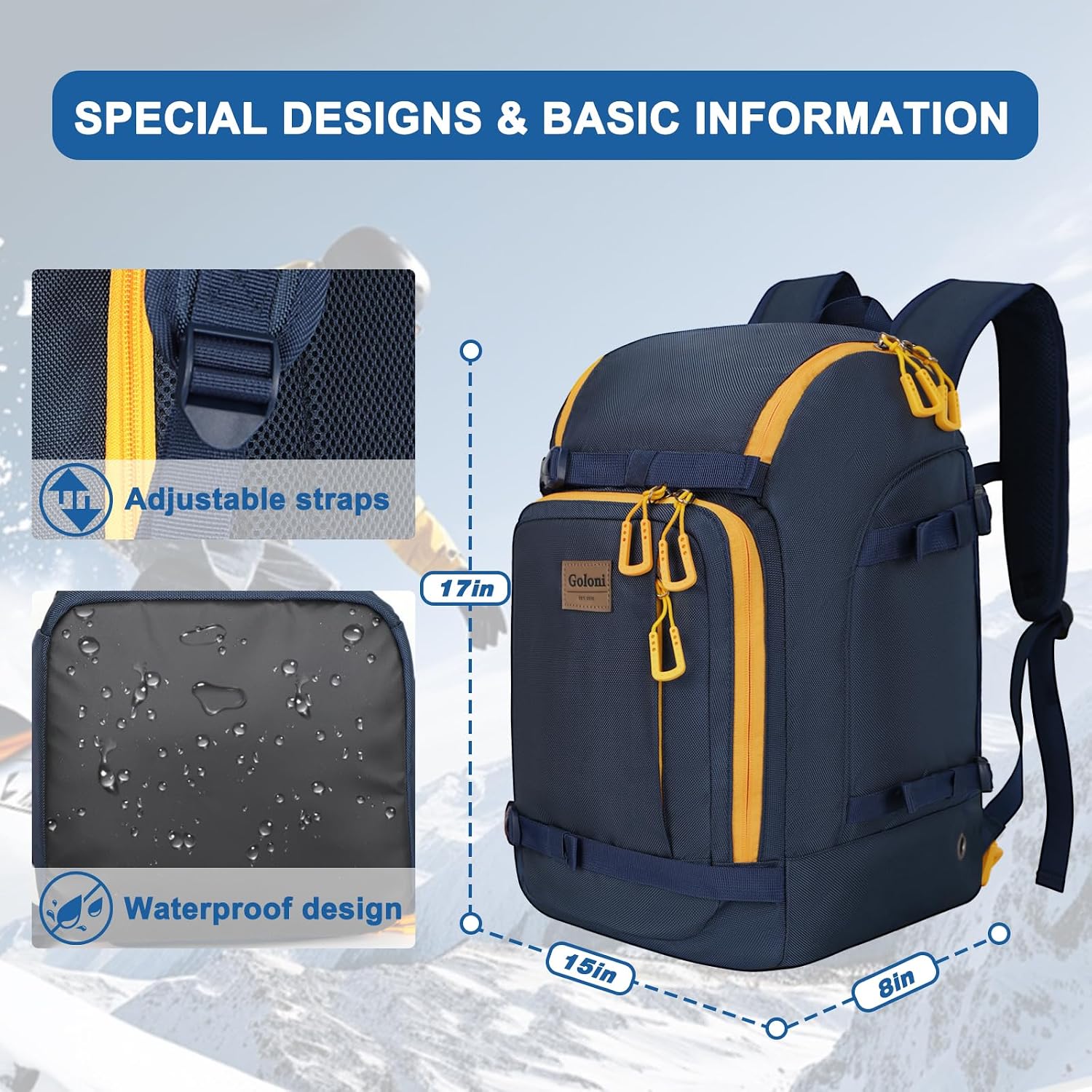
If you’ve ever watched a skier arrive at the lodge with boots jammed into a grocery bag while their helmet rides loose in the back seat, you already understand why a proper ski boot bag matters. A ski boot bag is a dedicated carrying bag designed to hold a pair of ski boots — the chunky plastic buckle-up kind that make walking on pavement feel like a science experiment — and often a helmet too. The sizing of these bags is measured in liters, the same way a hiking backpack is described. A higher liter number means more interior volume. The question that trips up most gift-buyers is: how many liters do you actually need? Boots and a helmet together take up more space than people expect, and buying one size too small means an expensive gift that sits unused. This guide does the liter math so you can give confidently, whether you’re shopping for a casual weekend warrior or a daily-driver resort skier.
The Liter Math: What Actually Fits in 50L vs. 70L
Let’s run the numbers before we name names. This is where most buying guides wave their hands and say “it depends.” Here, we’ll be specific.
By the numbers:
| What you’re fitting | Approximate volume |
|---|---|
| One pair of alpine ski boots (men’s size 9–11) | 18–22 L |
| One pair of alpine ski boots (women’s size 6–8) | 14–17 L |
| A ski or snowboard helmet (standard adult) | 10–13 L |
| Boot liner insoles + small accessories pocket use | 2–4 L |
| Wet gear buffer (gloves, goggles, base layer) | 4–8 L |
Add those up for the classic “boots plus helmet” load: a men’s setup lands comfortably between 30–35 liters just for the core items. A women’s setup sits closer to 26–30 liters. That leaves 15–20 L of breathing room in a 50L bag for extras — or roughly 35–40 L of real usable space in a 70L bag if you’re loading for an extended trip or stuffing in wet layers after a full day.
The practical decision rule for 50L: If the recipient is a day-tripper — park-and-ride, locker at the mountain, done by 3 pm — a 50L bag handles boots plus helmet with room for goggles, a neck gaiter, and a thin mid-layer. It stays compact enough to shoulder through a lodge without knocking people over. According to the REI Co-op Learn article “Ski & Snowboard Gear Bags Buying Guide,” 50L is the most common volume for skiers who keep a locker at their home mountain, precisely because the extra bulk of a 70L becomes unnecessary when you’re not transporting wet gear or multiple kit changes.
The practical decision rule for 70L: If the recipient travels to ski — checked bag, shuttle van, multi-resort trip — or if they’re the person who brings gear for the whole family, 70L earns its bulk. Gear Junkie’s “Best Ski Boot Bags Reviewed” roundup notes that the 70L class is where ventilated compartments, separate wet-dry zones, and integrated organizational systems become worth the price premium, because the bag is doing more jobs than just transporting boots from car to locker.
The Helmet-Plus-Boots Tradeoff Nobody Talks About
Here’s the friction point: helmets are awkward. They’re not dense, but they’re geometrically hostile. A helmet takes up roughly the same volume as three pairs of thick ski socks, but it doesn’t compress, and it won’t tolerate being squashed under a boot shell without scratching the lens mount or deforming the foam liner.
The better 50L bags solve this with a dedicated external helmet carry — either a separate zippered pocket on the bag’s face (sometimes called a “helmet cage” in manufacturer copy) or a compression harness on the outside. This matters for gift selection because a 50L bag without an external helmet pocket is effectively only a boot bag. The helmet ends up riding in a separate shopping bag or getting crammed into a main compartment that was designed for boots, meaning neither item fits comfortably. As Backpacker’s “Understanding Pack Volume and Fit” guide explains for hiking packs, stated volume is only meaningful if the volume is usably shaped — ski boot bags suffer the same issue when internal geometry doesn’t account for oddly shaped rigid items.
When you’re reading product specs, look for language like “external helmet carry,” “front helmet pocket,” or “fleece-lined goggle pocket separate from main compartment.” If those phrases aren’t in the description, assume the helmet shares the main compartment — and do the math on whether the remaining space handles two boot shells.
The 70L advantage here is less about raw space and more about geometry. A 70L boot bag typically opens clamshell-style (the whole bag unzips flat like a suitcase), which means boots and helmet can be placed side-by-side rather than stacked. Owners across aggregated reviews consistently report that clamshell-opening 70L bags make post-ski drying significantly easier — you can leave the bag open on a hotel luggage rack, vented, rather than propping it against a wall and hoping.
Price Tiers: What Changes at Each Level
Ski boot bags run from about $40 to well over $200, and the jumps in quality are real. The three tiers below each represent a meaningfully different product category — not just a price increment.
Budget Tier: Functional Basics ($40–$75)
Bags in this range handle the core job: padded boot compartment, some kind of helmet accommodation, a zipper that won’t fail mid-trip. Specs typically show 600D polyester construction — a mid-weight canvas-like fabric — with uninsulated walls and limited ventilation. For a casual skier who goes out five to ten days a season and keeps their boots at home between trips, this tier is honest value. Gear Junkie’s “Best Ski Boot Bags Reviewed” notes that bags in this range tend to sacrifice the wet-dry separation that matters most for après-ski commutes — wet gloves and dry merino base layers end up sharing space, which accelerates both odor and fabric breakdown.

Ski
$39.99
In stock on Amazon
Check price on AmazonMid-Tier: The Sweet Spot ($80–$130)
This is where the best-value decision lives for most recipients. At this price, you’re getting separated ventilated boot compartments — often a mesh-backed bottom section that allows airflow and odor management — a fleece-lined goggle pocket, and external helmet carry that’s actually sized for a full adult helmet rather than a youth lid. Outside Online’s “How to Pack a Ski Bag” guide consistently points to ventilation as the single most underrated feature in ski bags: wet boot liners left in an unventilated bag develop the kind of smell that becomes a gift-recipient complaint rather than a gift-recipient compliment. The 50L bags in this tier with proper external helmet cages are the correct default choice for the largest share of resort skiers.

Unigear
$69.99
In stock on Amazon
Check price on AmazonPremium Tier: Deliberate Construction ($150–$220+)
Dakine, Burton, and Atomic all publish 70L bags in this tier with reinforced boot-toe zones (the part that always abrades against pavement), YKK zippers rated for high-cycle use, and enough organizational depth to handle a full bootfitter’s worth of aftermarket insoles, heat-moldable liners, and spare buckles. According to the REI Co-op Learn “Ski & Snowboard Gear Bags Buying Guide,” the durability difference in this tier is most visible at the zipper pulls and boot-toe reinforcement panels — the first two points of failure on budget bags. Owners consistently report that premium bags outlast two or three budget replacements, and the cost-per-season math tends to favor the splurge once a skier is going out more than fifteen days a year. For a corporate retreat gift or a lodge host equipping a gear room, the brand visibility of a Dakine or Atomic bag also reads well in premium surroundings.

Unigear
$69.99
In stock on Amazon
Check price on AmazonSpecific Scenarios: If X, Then Y
This is the decision matrix worth bookmarking. Apply it to whoever you’re buying for.
Casual Resort Skier
Profile: 5–12 days per season, home mountain, keeps gear in a locker, drives to the hill. Recommendation: A 50L bag with external helmet carry, $75–$100 range. The geometry works, the price is right, and they won’t be hauling it through airports. Look for a ventilated boot section and a separate goggle pocket to keep lenses scratch-free.
Unigear
$69.99
In stock on Amazon
Check price on AmazonMulti-Resort Traveler
Profile: Flies to ski, checks bags, multi-day trips, multi-resort season. Recommendation: A 70L clamshell, $130–$180 range. The wet-dry separation and open-flat design make hotel drying practical. Budget for a TSA-compatible locking zipper pull if it’s going into checked luggage. Gear Junkie’s “Best Ski Boot Bags Reviewed” roundup identifies clamshell 70L bags as the most practical design for air travelers because unpacking is faster and re-packing is more forgiving when boots are still slightly damp.
Unigear
$69.99
In stock on Amazon
Check price on AmazonSerious Boot Customizer
Profile: Has custom footbeds, heat-moldable liners, aftermarket buckles, bootfitter relationship. Recommendation: A 70L bag with deep organizational pockets, $150–$220. They’re carrying significantly more than stock boots. They need dedicated slots for insoles, a liner-drying zone, and room for the small hardware that makes their setup work.
Unigear
$69.99
In stock on Amazon
Check price on AmazonYouth or Teen Skier
Profile: Boots run 2–4 sizes smaller than adult; helmet is a youth fit. Recommendation: Volume requirements drop significantly. A 35–40L bag handles youth boots and a youth helmet without the dead space of an adult 50L. Many brands publish youth-specific sizes in this range. Buying an adult 50L for a twelve-year-old creates a bag that’s too large to carry comfortably and too loose to protect the helmet from shifting during transport.
Ski
$39.99
In stock on Amazon
Check price on AmazonCorporate Retreat or Lodge Property Gift
Profile: Buying 10 or more bags for a branded experience, staff use, or lodge gear room. Recommendation: Prioritize brand consistency and visual uniformity. Dakine and Burton both offer ordering options in the $80–$120 per-bag tier. Gear Junkie’s reviews note that Dakine’s boot bag lineup is the most commonly cited in resort pro-shop gear rooms, partly because the colorways hold up against heavy use without fading and the hardware is repairable with standard replacement parts.
Unigear
$69.99
In stock on Amazon
Check price on AmazonThe Gift-Wrapping Problem (And Its Solution)
One practical note before you finalize the order: ski boot bags are large, oddly shaped, and difficult to gift-wrap gracefully. The better play for in-person gifts is to present the bag as the gift packaging — stuff it with a Smartwool base layer, a pair of ski gloves, or an insulated water bottle, and hand it over as a complete kit. The recipient opens the bag, finds gear inside, and the bag itself doesn’t need a bow. For online gifting, include a note explaining the liter choice so the recipient understands it wasn’t a random size — it was the right one for their specific setup, arrived at with actual math.
A 50L bag with an external helmet pocket and a ventilated boot compartment handles the overwhelming majority of resort skiers elegantly. A 70L clamshell is the upgrade for travelers, families, and anyone whose ski habit has scaled past weekend warrior into something that justifies a gear room. The math is straightforward; the tradeoffs are real; and now you can explain both without having to pretend you eyeballed it.