Ski boots are already the trickiest item to gift in any mountain sport — and alpine touring boots (the specialized boots used for both climbing uphill on skis and skiing back down, which snap into bindings that release at the heel for the ascent) add another layer of complexity. At $700–$900 for a flagship SCARPA model, getting the size wrong doesn’t mean a quick exchange at a local box store; it means a complicated return, a frustrated recipient, and a gifting moment that lands flat. The key to getting it right lives in a three-digit number you’ve probably seen on the tag but maybe never fully understood: Mondopoint, a boot-sizing standard that measures foot length in centimeters. This guide will walk you through exactly how that number works, where it breaks down, and what additional information you need before you commit to an $800 boot purchase as a gift.
If you’re already fluent in last widths and flex indexes, jump to the decision framework below. If not, the next section will catch you up in under two minutes.
| EDITOR'S PICKSCARPA Men's [Maestrale RS](https://www.amazon.com/dp/B0C5NZF3C6?tag=greenflower20-20) 130 F… | Mid-tierSCARPA Men's F1 Alpine Touring… | Budget pickSCARPA Men's 4-Quattro SL 120 F… | |
|---|---|---|---|
| Flex Rating | 130 | — | 120 |
| Mondo Size | 29 | 29.5 | 29.5 |
| GripWalk | — | — | ✓ |
| Price | $898.95 | $868.95 | $794.96 |
| See on Amazon → | See on Amazon → | See on Amazon → |
What Mondopoint Actually Measures — and What It Doesn’t
Mondopoint (often abbreviated MP) is an ISO standard that expresses boot sizing as the length of the foot in millimeters, divided by 10 to yield centimeters. A 26.5 MP boot is designed for a foot approximately 265 mm long. Simple enough — and significantly less ambiguous than the divergent U.S., UK, and European sizing conventions that vary by brand, country of manufacture, and decade the last was designed.
SCARPA, the Italian alpine boot maker, uses Mondopoint exclusively across its touring line, including the Maestrale RS, the Alien Carbon, the Gea RS, and the F1 XT. That’s the good news. The complication is that Mondopoint describes length only. It says nothing about:
- Last width — the measured width of the boot’s interior volume, typically expressed in millimeters at the widest point of the forefoot. SCARPA’s alpine touring lineup generally runs 98–102 mm last width depending on the model. Owners of wider feet (104 mm+) consistently report pressure points in SCARPA’s narrower-lasted touring models, particularly the performance-oriented Alien series.
- Flex index — a 0–130+ numerical rating for how stiff the boot’s cuff is in forward lean. Higher numbers mean a stiffer ride, which translates to better energy transfer on groomed descents but more fatigue on long uphill tours. SCARPA’s Maestrale RS sits around 120; the Alien Carbon pushes 130. First-time AT buyers gifting to someone who skis resort terrain a majority of the time often over-spec flex.
- Ramp angle — the angle of the footbed relative to the cuff, which affects how naturally the boot fits the foot’s standing geometry. This varies across SCARPA models and interacts with aftermarket insoles.
Per REI’s ski boot advice resource, fitting ski boots correctly requires knowing at minimum: foot length, foot width, intended use (resort vs. backcountry touring vs. ski mountaineering), and skier ability level. Gifting on length alone is a half-measure.
Reading a SCARPA Size Chart: Where the Conversions Live
| Mondopoint (MP) | US Men’s (approx.) | US Women’s (approx.) | EU (approx.) |
|---|---|---|---|
| 24.0 | 6 | 7 | 37 |
| 25.0 | 7 | 8 | 38–38.5 |
| 26.0 | 8 | 9 | 39–40 |
| 26.5 | 8.5 | 9.5 | 40–40.5 |
| 27.0 | 9 | 10 | 41 |
| 27.5 | 9.5 | 10.5 | 41–42 |
| 28.0 | 10 | 11 | 42–43 |
| 29.0 | 11 | — | 44 |
| 30.0 | 12 | — | 45–46 |
By the numbers:
- SCARPA’s AT boot lineup spans roughly MP 22.5 to MP 31.0
- Half-sizes are available in most models from MP 24.5 through MP 29.5
- Last widths across the lineup range from 97 mm (Alien Carbon) to 102 mm (Maestrale RS)
- SCARPA’s published shell fit recommendation: 10–15 mm of space between the longest toe and the shell interior for performance touring; 15–20 mm for recreational/comfort touring
These numbers come from SCARPA’s published fit documentation and are consistent with how the brand’s authorized dealers are trained to size customers. Gear Junkie’s alpine touring boot buyers guide notes that SCARPA tends to run slightly narrow and slightly short compared to some competitors — meaning a recipient who normally skis in a 27.5 from another brand may actually fit a 28.0 in SCARPA’s shell, depending on foot width and volume.
The Gift-Sizing Problem: What Information You Actually Need
Here’s where the practitioner calculus gets real. You’re not shopping for yourself. You’re sizing footwear that sits at the intersection of athletic performance and anatomical fit, for someone who isn’t in the room. Let’s be honest about the risk profile.
Scenario A: You have their current boot size in Mondopoint, from a boot they already ski. This is the best-case input. If the recipient already owns AT boots in, say, MP 27.0 that fit them well, the safest move is to match that number exactly in your target SCARPA model — then check whether the last width aligns. Owners who ski SCARPA’s Maestrale RS alongside, say, Dynafit’s TLT X report that the Maestrale runs slightly more generous in volume. If the recipient’s current boot is already snug on a narrow last, sizing up 0.5 MP in SCARPA may be warranted.
Scenario B: You have a U.S. or EU shoe size only. Use the conversion table above as a starting point, then apply the most important single correction: ski boots should fit tighter than street shoes. Most boot fitters recommend purchasing AT boots at the low end of your size range — if a recipient converts to MP 27.0–27.5, lean toward 27.0 unless you have specific information that they have wide feet or prefer a comfort fit. Outside Online’s ski boot coverage consistently flags this: the single most common gifting error is sizing up for “comfort” and delivering a boot that transmits power poorly and causes heel lift.
Scenario C: You’re guessing entirely. Don’t. This is the clearest decision rule in the article. An $800 AT boot is not a blanket or a fleece. It requires anatomical fit to function safely and perform as intended. If you don’t have enough sizing data, either (a) gift a gift card with a personalized note explaining the specific model you’d recommend and why — which is genuinely thoughtful — or (b) purchase from a retailer with a liberal boot-return policy and communicate clearly to the recipient that sizing confirmation is part of the gift experience.
Model-Specific Sizing Notes for SCARPA’s AT Lineup
Understanding the differences between SCARPA’s core alpine touring models matters before you pick a size, because the right model changes which size is right.
SCARPA Maestrale RS (~$750–$850 MSRP as of early 2026): The most broadly popular SCARPA AT boot in the North American market. Flex index approximately 120. Last width 102 mm — the most accommodating in the SCARPA touring lineup. Owners with medium-to-wide feet (100–104 mm) generally report a comfortable performance fit without significant customization. Per Powder Magazine’s AT boot coverage, this is the model most frequently recommended for skiers transitioning from resort to backcountry because the descent performance is high without requiring an extremely narrow foot.
SCARPA Alien Carbon (~$900–$950 MSRP): Designed for ski mountaineering and competitive touring. 97 mm last — genuinely narrow. Published weight is among the lightest in the AT boot category. Across aggregated reviews, the pattern is consistent: this boot rewards skiers who know their exact foot dimensions and have low-volume, performance-shaped feet. Gifting the Alien Carbon without a detailed sizing conversation is a significant risk. If the recipient hasn’t specifically mentioned ski mountaineering or suffered through other boots feeling “too beefy,” this is probably not the right choice.
SCARPA Gea RS (~$650–$750 MSRP): The women’s-specific touring boot in SCARPA’s lineup. Sized on a women’s last with a lower cuff height and reduced forward lean angle for anatomical fit. Gear Junkie notes the Gea RS consistently earns high marks from intermediate-to-advanced women touring skiers who want genuine descent performance without the volume of a men’s-last boot. Mondopoint sizing applies the same way; fit in the same range as the Maestrale RS for foot width.
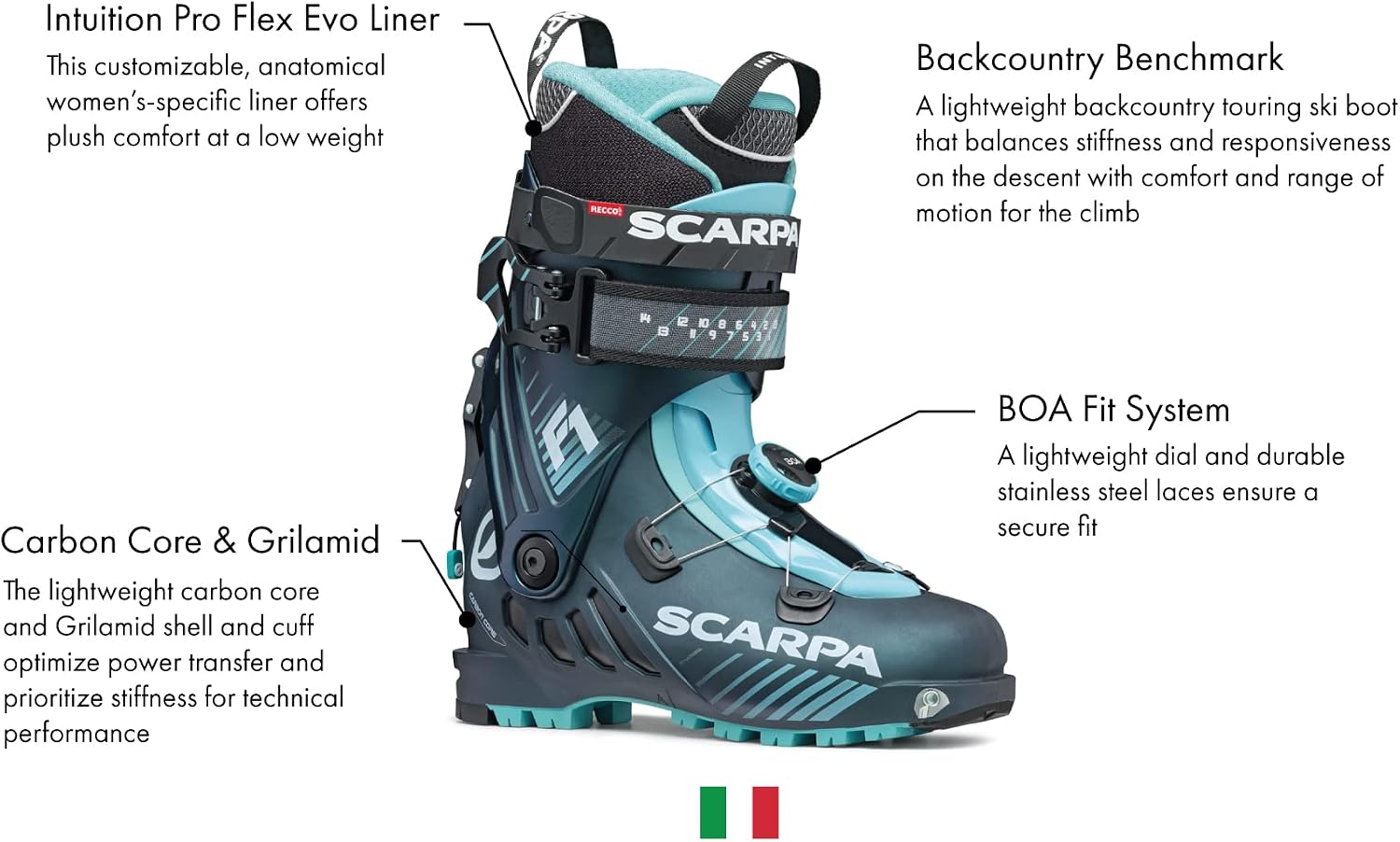
SCARPA F1 XT (~$800–$875 MSRP): Lighter than the Maestrale, stiffer than a soft-sided hybrid. 100 mm last. Best suited to skiers who prioritize uphill efficiency but still want a meaningful descent experience on varied terrain. Reviewers at Gear Junkie and Outside Online characterize it as sitting between the Maestrale and Alien in terms of intended use.
The Decision Framework: If X, Then Y
If the recipient already owns AT boots in a known Mondopoint size and reports they fit well → match MP exactly, then cross-reference last width between their current boot and your target SCARPA model. Adjust 0.5 MP if moving from a wide-lasted boot to a narrow one.
If you have only a U.S. or EU street shoe size → convert using the table, then size down 0.5 MP from the midpoint of their converted range. Ski boots fit tighter than street shoes by design.
If the recipient is new to AT boots and coming from alpine resort boots → prioritize the Maestrale RS over the Alien Carbon or F1 XT. The 102 mm last forgives fitting imprecision better than the narrower performance models, and the flex index is appropriate for the broadest range of ability levels.
If you do not have reliable foot length data → do not guess. A gift card for the specific model, paired with a written recommendation explaining the choice, is a more useful gift than an $800 boot that requires a complicated return. Retailers with boot-fitting programs (many independent alpine specialty shops still offer complimentary fitting with purchase) can make the gift card redemption feel curated rather than impersonal.
If the recipient has wide feet or has complained about narrow boots before → rule out the Alien Carbon entirely and verify the Maestrale RS at 102 mm last will accommodate their foot width before purchasing. Some fitters recommend custom footbeds, which add $75–$150 to the total cost but meaningfully improve fit in all SCARPA models.
The Mondopoint number is the starting point, not the finish line. Get the length right, verify the width, match the model to the use case, and you’ll deliver one of the most technically satisfying gifts in the alpine sport category. Get it wrong, and you’ve created a return-shipping problem. The research is worth doing — that’s the whole point of this guide.