If you’ve ever stood in a gear shop — or scrolled through a brand’s website — and felt like every ski pack somehow looks identical until you dig into the details, you’re not imagining it. A ski pack is simply a backpack built for mountain days on snow: it carries your layers, water, snacks, and critically, safety gear like an avalanche beacon (a device that sends and receives radio signals to help rescuers find buried skiers), a folding shovel, and a collapsible probe pole. Osprey, one of the most trusted names in technical packs, has organized its ski-specific lineup around four distinct use cases — the Firn, Soelden, Sopris, and Glade — and the differences between them are real enough to matter. This guide breaks down exactly who each pack is built for, where the tradeoffs live, and which one earns a spot on your back given what you’re actually doing on the hill.
| EDITOR'S PICK[Osprey Sopris 32L Ski and Snowb…](https://www.amazon.com/dp/B0FC45X1CC?tag=greenflower20-20) | Mid-tier[Osprey Kamber 20L Men's Backcou…](https://www.amazon.com/dp/B092YHV9N6?tag=greenflower20-20) | Budget pick[Osprey Glade 12L Ski and Snowbo…](https://www.amazon.com/dp/B0CB1QHL5G?tag=greenflower20-20) | |
|---|---|---|---|
| Capacity | 32L | 20L | 12L |
| Material | 100% Recycled Nylon | — | — |
| Avy Gear Carry | ✓ | — | — |
| Hydration Inc. | — | — | ✓ |
| Women's Fit | ✓ | ✗ | — |
| Price | $195.00 | $145.19 | $78.00 |
| See on Amazon → | See on Amazon → | See on Amazon → |
The Quick Map: What Each Pack Is Trying to Solve
Before getting into individual models, it helps to understand that Osprey organized this lineup along two axes: volume (how much the pack carries, measured in liters) and mission (resort day-use versus sidecountry and backcountry travel). The Glade sits at the compact, resort-friendly end. The Soelden is the big-volume workhorse for multi-day or guide-level loads. The Firn and Sopris land in the middle but serve different riders — Firn is the gender-neutral performance-backcountry option, while Sopris carries Osprey’s women’s-specific fit geometry.
Here’s a snapshot of the core specs across all four, per Osprey’s published 2025–2026 collection data:
| Pack | Volume | Airbag-Ready? | Primary Use |
|---|---|---|---|
| Glade | 12L | No | Resort / sidecountry day |
| Firn | 30L / 36L | Yes (FlapJacket) | Backcountry, touring |
| Sopris | 30L / 40L | Yes (FlapJacket) | Backcountry, women’s fit |
| Soelden | 32L / 42L | Yes (FlapJacket) | High-output touring, guides |
“Airbag-ready” here means the pack is built with Osprey’s FlapJacket integration system, which allows compatible airbag bladder modules to be added without buying an entirely new pack — a meaningful long-term cost consideration if you’re thinking about avalanche airbag technology down the road.
Glade: The Case for Keeping It Simple
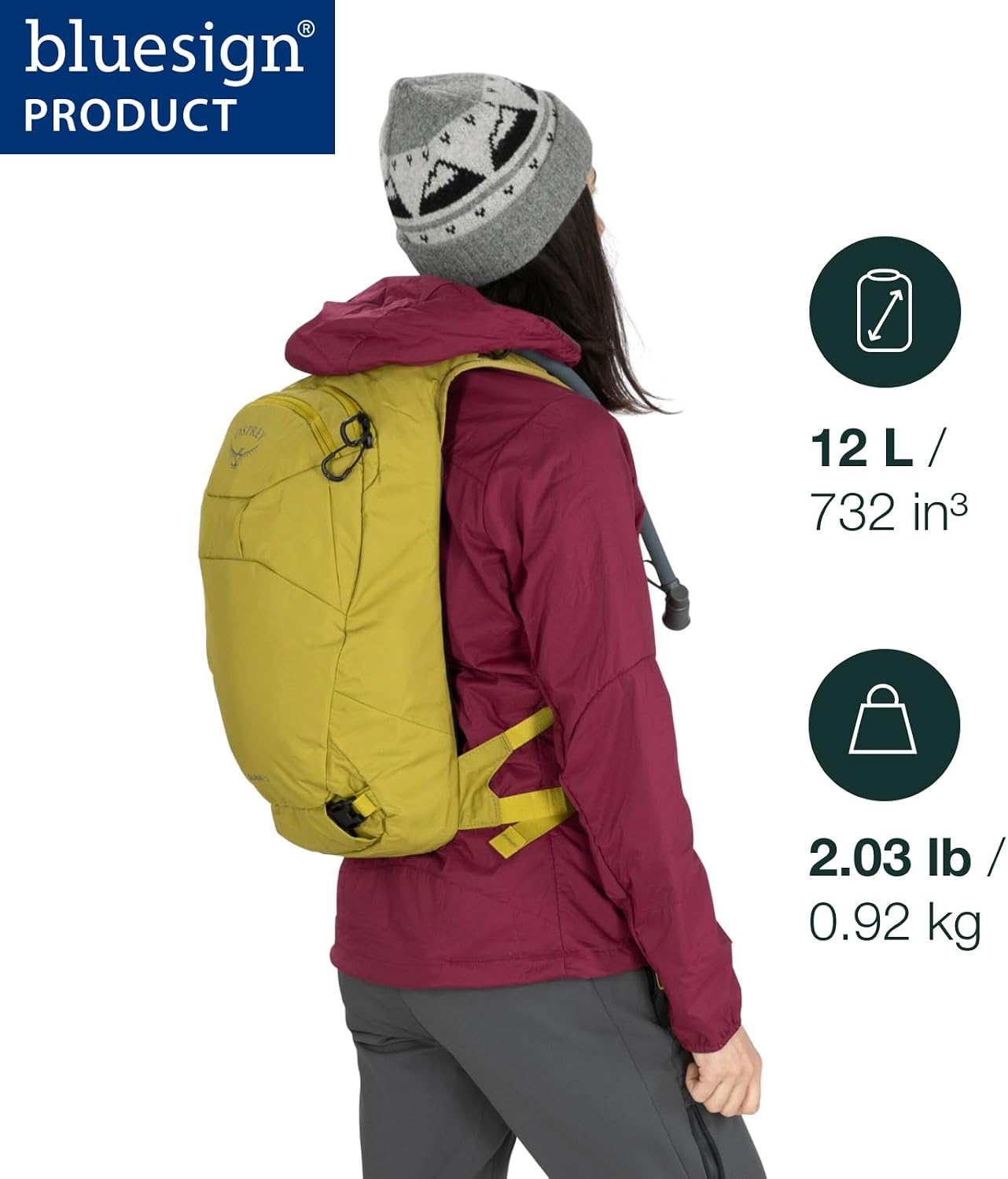
The Glade (12L) is Osprey’s answer to the question: what if I don’t need to haul much, but I want a pack that actually works for skiing? It’s a resort-oriented daypack built for riders who are mostly on-piste (meaning groomed, patrolled ski runs) or making very short sidecountry excursions — think bootpacking 200 meters off a lift-accessed ridge, not multi-hour tours.
What owners and reviewers consistently appreciate about the Glade is how well it manages ski-carrying ergonomics at a compact size. The A-frame ski carry — a system where skis are strapped diagonally across the pack in a triangular configuration — is clean and doesn’t swing wide on tight tree runs. The Glade also carries a dedicated sleeve for a hydration reservoir (a water bladder that sits inside the pack and connects to a drinking tube), which removes the need to stop and dig for a water bottle every hour.
What it doesn’t have: a dedicated avalanche gear organization system, an airbag-ready chassis, or enough volume to carry a meaningful change of layers for variable mountain weather. Outside Online’s guide to choosing ski packs specifically notes that packs below 20L are best matched to controlled-access terrain and riders who aren’t carrying full safety kits.
If you’re primarily a resort skier who occasionally ventures into a low-consequence sidecountry zone, the Glade is an honest, right-sized choice. If you’ve got ambitions to start touring in earnest within the next season or two, you’ll outgrow it quickly — and you can’t add an airbag module.
Firn vs. Sopris: Same Mission, Different Chassis
The Firn (30L and 36L) and Sopris (30L and 40L) are the lineup’s core backcountry performers, and they’re closely matched enough that the choice between them is almost entirely about fit geometry.
The Firn is built on Osprey’s gender-neutral AirScape back panel — a tensioned mesh suspended slightly away from your back to allow airflow during high-output skinning (skinning = climbing uphill on skis using adhesive climbing skins attached to the base, the standard uphill travel method in backcountry touring). Reviewers at Gear Junkie consistently describe the Firn’s fit as neutral and adaptable, working well for torsos between 16 and 21 inches. The pack’s organization is purpose-built for backcountry safety discipline: a dedicated avalanche rescue pocket on the front panel keeps beacon, probe, and shovel accessible without opening the main compartment, which matters when seconds count in a rescue scenario.
The Sopris carries the same safety architecture but is built on Osprey’s LadyBird back panel — a shorter torso length, repositioned shoulder straps with a narrower stance at the top, and hip-belt wings shaped for wider hips relative to waist measurement. Osprey’s own fit documentation describes the Sopris as optimized for torso lengths between 14 and 19 inches. Powder Magazine’s 2025–2026 ski pack roundup specifically flagged the Sopris 30 as one of the best-fitting options for women in the mid-volume touring category, noting that the load transfer to the hip belt felt more direct than comparable gender-neutral options.
The honest tradeoff: if you’re a narrower-shouldered rider with a shorter torso and the Sopris fits your frame, you’ll likely get better load transfer on big vert days — which matters when you’re carrying 25+ pounds of touring gear and safety kit. If you’re between sizes or have a longer torso, the Firn’s neutral geometry may actually serve you better. Backpacker Magazine’s pack fit guide notes that no amount of strap adjustment fully compensates for a torso length mismatch, which is why Osprey keeps both options in the lineup rather than collapsing them into one.
The 36L Firn and 40L Sopris are worth considering if you’re regularly doing full-day tours with bivy potential, carrying emergency shelter, or guiding others and carrying group gear. The 30L versions are honest fits for 4–7 hour days with a standard safety kit plus layers and lunch.
Both packs support Osprey’s FlapJacket airbag integration, which uses a snap-and-zip attachment system at the pack’s top panel. Reviewers note that the module adds roughly 1.5–2 pounds to carry weight, so it’s worth thinking of the airbag as a separate purchase decision rather than a day-one default.
Soelden: The High-Capacity Workhorse
The Soelden (32L and 42L) is where Osprey pushed the design envelope toward professional and high-output touring use. It shares the airbag-compatible FlapJacket architecture and safety-gear organization of the Firn and Sopris, but the chassis is built for heavier loads over longer terrain.
The back panel system on the Soelden is Osprey’s Ag7 suspended mesh — a stiffer, more structured suspension than the AirScape — which distributes load more aggressively to the hip belt at the cost of a slightly warmer carry. For ski mountaineering objectives (think elevation gains of 3,000–5,000 feet with a pack over 25 pounds), owners report that the Soelden’s load transfer is noticeably more supportive than its stablemates. The structure also makes the pack more stable when moving through exposed terrain where pack sway becomes a safety issue.
The Soelden 42 is the option in this lineup that makes sense for guides, splitboard mountaineering (splitboarding = snowboarding on a board that separates into two ski-like halves for uphill travel), or anyone who regularly carries group gear, a rope system, or overnight kit. At 42L, it’s also at the upper edge of what works comfortably as a ski-specific pack — anything larger starts to compromise your ability to manage the pack while actually skiing.
Gear Junkie’s Soelden 32 review noted that the pack excels when loaded between 18–28 pounds and becomes less comfortable below that range, because the stiffer frame structure is designed to work under tension. For lighter day-use loads, the Firn or Sopris will feel more natural.
The cost consideration: The Soelden 42 carries a price premium of roughly $40–$60 over the Firn 36 at standard retail, per Osprey’s 2025–2026 MSRP structure. If you’re genuinely doing the kinds of days that justify the Soelden’s capacity, that delta is easy math. If you’re convincing yourself you’ll “grow into it,” the Firn 36 is probably the more honest choice.
The Decision Frame: If X, Then Y
Here’s where practitioners tend to lose time: they evaluate these packs on features in isolation rather than matching the pack to the actual days they’re doing. Based on published specifications, aggregated owner feedback, and editorial coverage across Powder Magazine, Outside Online, and Gear Junkie, the decision logic looks like this:
If you’re a resort skier or early sidecountry explorer not yet carrying a full safety kit: → Glade 12L. It’s honest about what it is.
If you’re touring 1–4 days per week, carrying beacon/shovel/probe, and have a torso 16” or longer: → Firn 30L (for days up to 6 hours) or Firn 36L (for longer objectives or guide-adjacent loads).
If you’re the same rider but have a shorter torso and/or find gender-neutral packs tend to fit poorly at the shoulder: → Sopris 30L or 40L. The fit difference on a long skinning day is real, and it’s worth trying both back systems before committing.
If you’re regularly doing 4,000+ vertical foot tours, guide work, splitboard mountaineering, or carrying group kit: → Soelden 32L or 42L. The stiffer suspension earns its price premium under load.
If you’re planning to add an airbag module in the next 1–2 seasons: → Any of the Firn, Sopris, or Soelden options support Osprey’s FlapJacket system. The Glade does not. Factor the airbag module cost (~$300–$400 for most compatible systems) into your total budget now, not later.
One footnote worth making explicit: Osprey’s sizing within these models runs true to their published torso measurements, per the brand’s own fit documentation. If you’re between the 30L and 36L/40L options and you ski in a region with highly variable weather (heavy clothing days versus light spring touring), trending toward the larger volume is the lower-regret call. You can always fill a bigger pack; you can’t compress a smaller one.
Osprey’s ski lineup isn’t complicated once you know what each pack is trying to do — they’re just solving different problems for different days. Match the pack to your actual terrain and load, not to the most aspirational version of your ski season, and you’ll get years of honest use out of whichever one you pick.