If you’ve started researching backcountry ski packs — meaning packs designed specifically for skiing or hiking in untracked, avalanche-terrain mountain environments — you’ve probably noticed that every serious recommendation eventually lands on two European brands: Ortovox and Deuter. Both have been building mountain packs for decades. Both take avalanche safety seriously enough to integrate rescue tool storage (the dedicated slots for a beacon, shovel blade, and collapsible probe pole that are collectively called your “safety system”) directly into the pack’s architecture. And both command prices in the $220–$700 range that signal genuine backcountry intent, not lift-line posturing. So what actually separates them? This article breaks down the core design philosophies, spec-by-spec tradeoffs, and real-world use patterns that should push you toward one or the other — because at this price point, “they’re both good” is not a useful answer.
| EDITOR'S PICK[Deuter Unisex Freerider 30L](https://www.amazon.com/dp/B0DP2WJQGF?tag=greenflower20-20) | Mid-tier[Deuter Freescape Lite 26 Ski To…](https://www.amazon.com/dp/B0BP7JZG41?tag=greenflower20-20) | Budget pick[Ortovox Tour Rider 30L Ski Tour…](https://www.amazon.com/dp/B0B2YJ9J72?tag=greenflower20-20) | |
|---|---|---|---|
| Volume | 30L | 26L | 30L |
| Gender | Unisex | — | — |
| Color | Savanna-Nori | Papaya-Umbra | Petrol Blue |
| Price | $200.00 | $152.15 | $108.00 |
| See on Amazon → | See on Amazon → | See on Amazon → |
The Brand DNA Problem: Why This Comparison Matters More Than It Looks
Ortovox was founded in 1968 specifically around avalanche rescue. The company invented the first three-antenna digital avalanche transceiver — the device you wear on your body that lets rescuers find you under snow — and has spent over fifty years building packs as extensions of that safety ecosystem. That heritage is not marketing copy. It shapes every decision from zipper placement to harness geometry.
Deuter, by contrast, is one of Germany’s oldest pack makers, founded in 1898, with deep roots in general alpine and expedition packing. They came to backcountry ski-specific design from a different angle: a trekking and climbing brand that became increasingly technical over time. Their Aircontact and Futura suspension systems — engineered for multi-day load carry — are among the most reviewed load-management architectures in the category, as noted in REI Expert Advice’s guide “How to Choose a Ski Touring Pack” on rei.com/learn.
This difference in origin story is not trivial. It produces packs that prioritize different things even when the volume, weight, and price look nearly identical on a spec sheet.
Safety-System Integration, Suspension, and Airbag Options: Three Axes That Define the Choice
Safety-System Access: Where Ortovox Has the Structural Advantage
The most important organizational question for any backcountry pack is: how fast can you get to your shovel when it matters? In an avalanche rescue scenario, every second of burial time increases risk to the victim. Pack design that buries your shovel under your lunch and an extra layer costs time you may not have.
Ortovox’s approach to this problem is what the brand calls the “Safety Zone” — a dedicated external or top-of-pack compartment that holds your shovel and probe completely separately from the rest of your load. On packs like the Ascent 32+ and the Freerider 30, this compartment is reachable without opening the main body at all. Owners and field testers consistently report that the geometry makes single-hand access intuitive even with gloves on. GearJunkie’s “Best Avalanche Packs for Backcountry Skiing” 2025 buyer’s guide specifically flags this separation as a key differentiator for guides and patrol staff working in high-consequence terrain.
Deuter’s Freerider Pro series uses a different approach: a dedicated bottom compartment with a quick-access avalanche tools pocket that keeps the shovel blade and probe sleeved vertically. It is thoughtfully designed and well-reviewed, but the access path requires unclipping a bottom buckle rather than a clean top-lid grab. The tradeoff is that Deuter’s shovel compartment leaves more volume uninterrupted in the main body — better for packing efficiently on longer objectives.
The tradeoff named plainly: If your primary use is day or half-day sidecountry — terrain accessed from a lift but outside the patrolled boundary — where avalanche rescue speed is the overriding variable, Ortovox’s Safety Zone architecture is purpose-built for that scenario. If you’re doing longer ski tours or multi-pitch alpine routes where a clean main compartment and efficient load management matter as much as emergency access, Deuter’s design compromise is more defensible.
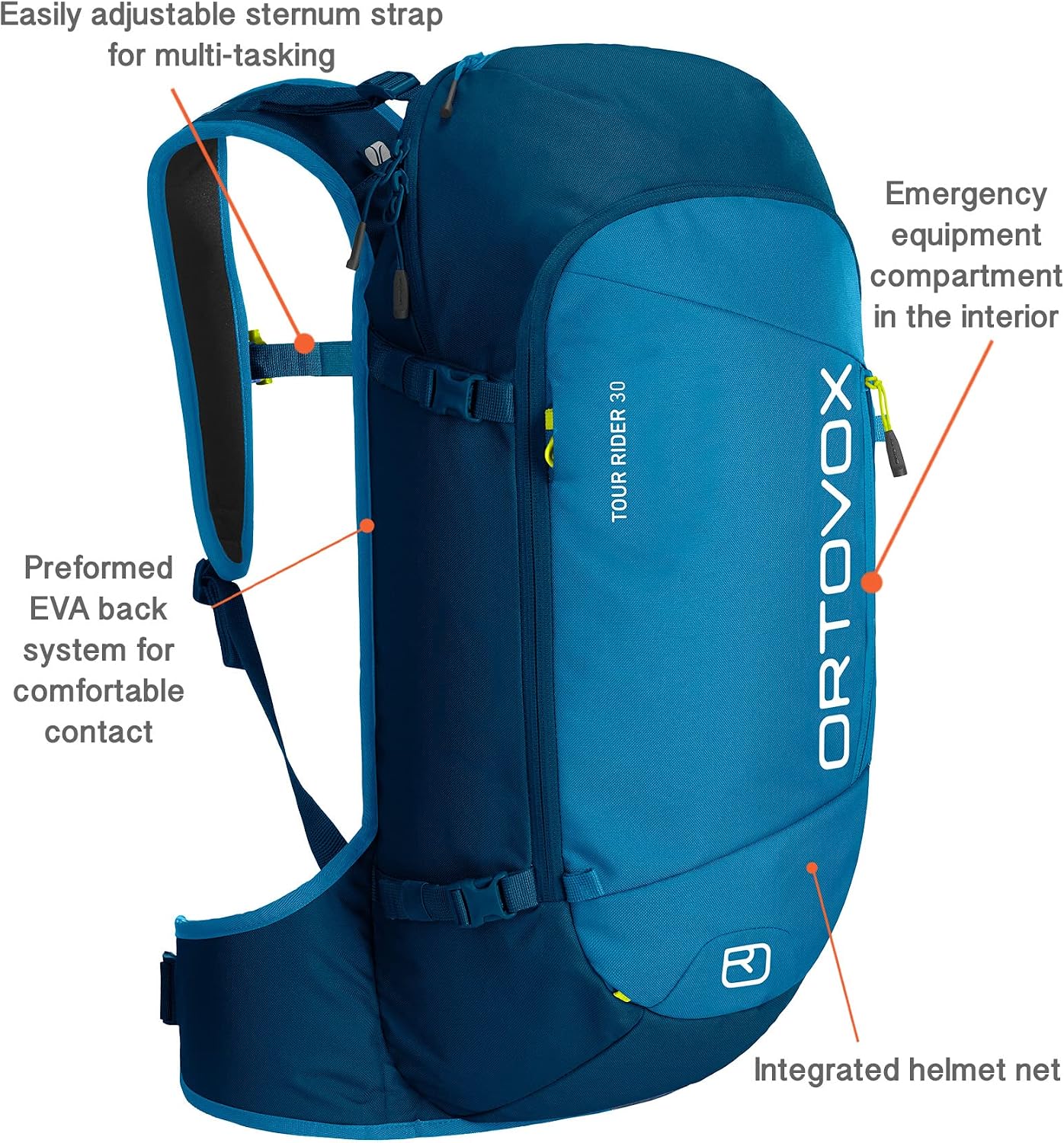
Ortovox
$108.00
In stock on Amazon
Check price on AmazonSuspension, Fit, and Load Transfer: Deuter’s Engineering Edge
Here is where the brand histories invert the advantage.
Deuter’s Guide 44+ and Freerider Pro 32 use a refined aluminum stay suspension — a pair of lightweight metal rods shaped to follow your spine’s natural curve that transfer pack weight to your hip belt rather than hanging it from your shoulders. For loads above 20 pounds, which is common once you add a rope, extra layers, lunch, and a full safety kit, this distinction becomes physical. Backpacker Magazine’s reference guide “How to Fit a Backpack” explains the mechanics of stay-based load transfer in detail, and reviewers at GearJunkie consistently rate Deuter’s carry comfort above the category average for loads in the 25–35 lb range.
Ortovox’s suspension on ski-specific packs like the Ascent series uses a more minimal framesheet — a stiff flat insert rather than curved stays — that works well for ski-touring loads under about 20 pounds and keeps the pack closer to your body for dynamic movement on skis. When you’re skinning (climbing uphill on skis using adhesive climbing strips on your bases), a pack that sits tight and doesn’t shift laterally is worth real energy savings over a long day. The tradeoff is that heavier loads begin to fatigue shoulders faster without the load-transfer geometry of a full aluminum stay system.
Freerider Pro 32 Head-to-Head Specs (source: Ortovox and Deuter product documentation, May 2026):
| Spec | Ortovox Ascent 32+ | Deuter Freerider Pro 32 |
|---|---|---|
| Volume | 32 L | 32 L |
| Manufacturer-listed weight | ~1,400 g | ~1,550 g |
| Frame type | Framesheet | Aluminum stays |
| Airbag compatible | Yes (Avabag system) | Yes (Avalanche Airbag) |
| Safety compartment access | Top-lid external | Bottom-zip vertical sleeve |
| Hip belt pockets | Yes | Yes |
| Helmet carry | Front bungee | Front bungee |

Deuter
$152.15
In stock on Amazon
Check price on AmazonAirbag Compatibility: A Necessary Detour
Both brands offer airbag-ready versions of their flagship ski packs. An avalanche airbag is an inflatable bladder — triggered by a handle you pull if caught in a slide — that dramatically increases your volume and helps keep you near the surface of moving snow. Avalanche.org’s Know Before You Go avalanche education resource notes that airbag deployment has been associated with meaningful reductions in burial depth in documented avalanche events, though it is not a substitute for terrain management and beacon skills.
Ortovox uses its proprietary Avabag system, which runs on a rechargeable lithium-ion cylinder. The practical benefit: you can repack and recharge without replacing a cartridge, which matters if you’re on a multi-week trip in a remote range. The Avabag unit adds approximately 800g to the base pack weight, and the trigger mechanism integrates cleanly into the shoulder strap without a protruding handle that catches on trees or ski gates.
Deuter partners with compressed-air cartridge systems on their airbag-compatible models. The cartridge approach uses a simpler mechanical deployment with no battery to manage, but it means carrying spare cartridges if you’re touring for multiple days without resupply access. REI Expert Advice’s “How to Choose a Ski Touring Pack” on rei.com/learn notes that airbag cartridges require removal before air travel and that travelers should always verify current airline policy before flying internationally with any airbag pack, regardless of brand.
The tradeoff named plainly: Ortovox Avabag wins on a multi-day hut-to-hut ski traverse where recharging matters. Deuter’s cartridge system is lighter before deployment and easier to understand mechanically for a newer airbag user who wants fewer variables.

Deuter
$200.00
In stock on Amazon
Check price on AmazonPrice Architecture and Where to Enter
As of May 2026, the non-airbag Ortovox Ascent 32+ and Deuter Freerider Pro 32 each retail in the $220–$280 range. Airbag-integrated versions of both push to $550–$700 depending on the cylinder system. This is a meaningful spend, and the decision frame at each price tier is different.
At the $220–$280 tier (non-airbag): You’re buying the organizational system and harness geometry. Buy Ortovox if safety-zone access and skinning ergonomics are your primary variables. Buy Deuter if you’re also using the pack for spring mountaineering or longer-load alpine routes where carry comfort at 25-plus pounds matters.
At the $550–$700 tier (airbag-integrated): The airbag system becomes the most important variable. If you tour frequently and recharging convenience matters, Ortovox Avabag is the cleaner long-term proposition. If you’re a weekend backcountry user who wants simplicity and doesn’t want to manage a battery, Deuter’s cartridge-based integration removes one cognitive load from an already demanding pursuit.
One note on budget sequencing: the backcountry safety community, including instructors at most AIARE (American Institute for Avalanche Research and Education) avalanche courses, consistently recommends prioritizing beacon, shovel, and probe quality over airbag deployment. Those three tools are always in play in a rescue scenario. The airbag is insurance layered on top of a solid system — not a substitute for it. If your budget forces a choice between a quality non-airbag pack and a cheaper airbag pack, invest in the safety tools first.
The Clear Decision Rule
This is the kind of comparison where the right answer genuinely depends on how you use terrain, and both packs earn their reputations among serious practitioners. But here is the honest framework:
Choose Ortovox if: Your primary use is sidecountry laps, guided days in avalanche terrain, or scenarios where fast safety-tool access is the single most important variable. The Safety Zone architecture and tight skinning profile are purpose-built for this use pattern. For multi-week tours or remote ranges, the Avabag rechargeable system also earns its premium.
Choose Deuter if: You’re doing longer ski tours of five-plus hours, mountaineering routes, or hybrid objectives where the pack carries 25-plus pounds and functions as your home base for a full day or multi-day push. The aluminum stay suspension earns its small weight penalty on long hauls. For weekend users who want airbag simplicity, the cartridge system is easier to manage.
Neither pack will disappoint a serious user who matches it to their actual objectives. But understanding which brand’s obsessions align with yours — Ortovox’s rescue-system heritage or Deuter’s load-management engineering — is how you stop second-guessing a $300 purchase halfway up the skin track.