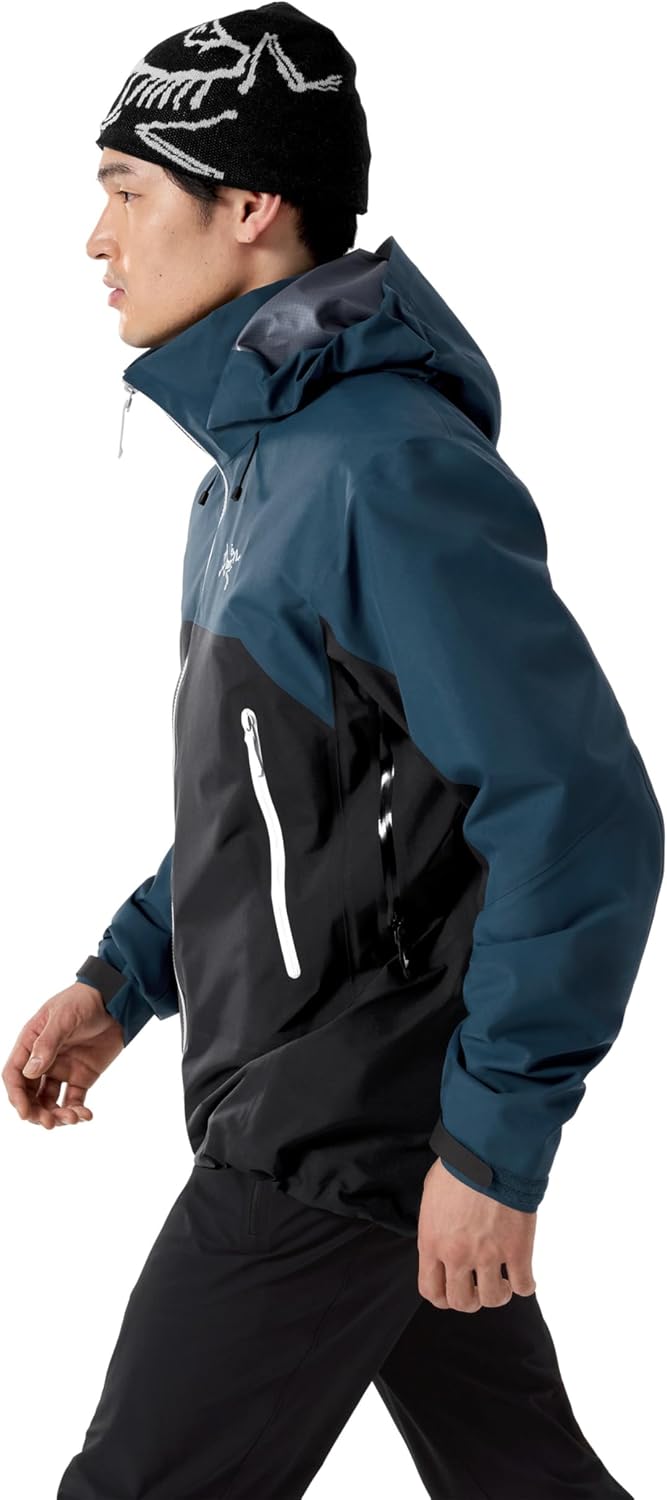
If you’ve ever stood in a ski shop — or scrolled a gear retailer at midnight — staring at two jackets that both claim to be “waterproof and breathable,” you know the frustration. The $750 Arc’teryx shell says Gore-Tex Pro on the tag. The $350 Helly Hansen says HellyTech Protection. Both repel rain. Both look serious. So what are you actually paying for, and does the recipient of your gift care?
A shell jacket is a lightweight outer layer designed to block wind and water without built-in insulation — the outermost armor in a layering system. The membrane — the ultra-thin laminate bonded inside the fabric — is what makes the jacket waterproof while still letting sweat vapor escape. Gore-Tex Pro and HellyTech are two different membrane systems, engineered to different performance standards and priced accordingly. This guide breaks down what the specs actually mean, where the performance gap is real, and how to match the right jacket to the person you’re buying for.
What the Membranes Actually Do — and Where They Differ
Both systems rely on the same basic physics: a membrane full of microscopic pores too small for liquid water droplets to enter, but large enough for water vapor molecules to escape. The difference is in how that membrane is constructed, how it’s attached to the face fabric, and how it holds up to abrasion and repeated compression over years of use.
Gore-Tex Pro is W. L. Gore & Associates’ flagship construction. Per W. L. Gore & Associates’ published product technology documentation, it uses a three-layer laminate: the outer face fabric, the ePTFE (expanded polytetrafluoroethylene) membrane, and an inner backer fabric are all bonded together into a single panel. This eliminates the loose inner lining common in cheaper jackets and means the membrane is mechanically protected from both sides. Gore-Tex Pro also specifies a minimum durability threshold — fabrics must meet Gore’s “Guaranteed to Keep You Dry” standard, which includes ongoing quality audits of partner manufacturers. Gore’s published spec documentation places water-entry resistance (hydrostatic head) at 28,000mm or higher for Pro-tier fabrics, compared to 20,000mm for standard Gore-Tex.
HellyTech is Helly Hansen’s proprietary system, offered in three tiers: HellyTech Essential (entry-level), HellyTech Performance (mid), and HellyTech Protection (top). The top tier uses a 3-layer construction similar in concept to Gore-Tex Pro, but the membrane chemistry is Helly Hansen’s own and quality audits are conducted internally rather than by a third-party licensor. Helly Hansen’s published technical documentation rates HellyTech Protection at a 20,000mm hydrostatic head and 20,000g/m²/24hr moisture vapor transmission — solid numbers for resort skiing and all-day hiking, but below Gore-Tex Pro’s published ceiling.
The honest translation: Gore-Tex Pro sets a higher floor and a higher ceiling, enforced by a licensor who can pull certification. HellyTech Protection is a legitimate performer for most mountain use cases, but the durability story is self-reported rather than independently audited. That distinction matters more at year three than at unboxing.
By the Numbers: A Side-by-Side Spec Comparison
The table below draws on W. L. Gore & Associates’ published product technology documentation and Helly Hansen’s HellyTech technology brief. MVTR figures are manufacturer-rated under ISO 11092 or equivalent; real-world breathability varies with humidity differential and activity level.
| Spec | Gore-Tex Pro | HellyTech Protection |
|---|---|---|
| Construction | 3-layer laminate | 3-layer laminate |
| Hydrostatic head (min.) | 28,000mm | 20,000mm |
| Breathability (MVTR) | ~25,000 g/m²/24hr | ~20,000 g/m²/24hr |
| Durability auditing | Third-party (W. L. Gore) | In-house (Helly Hansen) |
| Typical retail window | $550–$850+ | $300–$450 |
| Weight (representative jacket) | ~350–420g | ~420–520g |

Arc'teryx
$552.50
In stock on Amazon
Check price on Amazon
Helly
$450.00
In stock on Amazon
Check price on Amazon
Nikwax
$24.50
In stock on Amazon
Check price on AmazonThe Real Performance Gap: When It Matters and When It Doesn’t
Here’s the tradeoff most gifters get wrong: they assume the premium membrane is “overkill” for a recreational skier. Sometimes it is. But the performance gap between Gore-Tex Pro and HellyTech Protection isn’t primarily about a single day in the rain — it’s about cumulative exposure and wear patterns.
Review coverage at Outside Online and Gear Junkie consistently notes that Gore-Tex Pro jackets maintain their dri-feel and delamination resistance after two to four seasons of heavy use in a way that mid-tier laminates rarely match. The face fabric on HellyTech Protection jackets tends to wet-out — losing its DWR (Durable Water Repellent) coating and beginning to absorb surface moisture — faster under sustained heavy use. REI Expert Advice’s guide “How to Choose a Rain Jacket,” published on rei.com/learn, recommends regular DWR reapplication for all waterproof-breathable shells to maintain performance, noting that the underlying membrane’s long-run durability is what separates premium from mid-tier constructions.
Where HellyTech Protection punches above its price: resort skiing in groomed conditions, weekend hut trips, and occasional mountain users who wear their jacket two or three weeks per season. Powder Magazine’s seasonal ski jacket roundups have repeatedly recognized Helly Hansen’s Odin collection as best-in-class value for this use case, citing excellent fit, well-placed pockets, and a fabric hand that feels premium without the clinical stiffness of some Gore-Tex laminates.
Where Gore-Tex Pro justifies the delta: guides, ski patrollers, backcountry splitboarders, and anyone putting 40–80 days per season on a single jacket. The cost-per-use math shifts dramatically here. A $750 Gore-Tex Pro shell that performs reliably for five seasons at 50 days per year works out to roughly $3 per day. A $380 HellyTech jacket that requires replacement or significant DWR restoration at season three approaches a similar or higher figure with more friction involved. Long-term review coverage from Gear Junkie on technical alpine shells consistently highlights sustained performance through multi-season backcountry use as the primary Gore-Tex Pro justification.
Matching the Jacket to the Recipient: Three Tiers
This is where the gifting calculus gets specific. The membrane choice should follow the use case, not the prestige of the label.
The Backcountry Devotee
Budget range: $550–$850+
If your recipient skins uphill before skiing down, spends time in the sidecountry, or guides others in mountain terrain, Gore-Tex Pro is the correct answer. The breathability ceiling matters here — climbing in a jacket that doesn’t vent adequately creates a wet-from-the-inside problem that no waterproof rating can fix. The Arc’teryx Beta AR and the Mammut Nordwand Pro are anchor picks in this tier, both reviewed extensively by Outside Online and Gear Junkie, with owner reports and spec sheets converging on the same conclusion: these are tools for people who live in the mountains. The durability auditing provided by W. L. Gore & Associates’ third-party certification process is the differentiator that justifies the price at this use intensity.
Arc'teryx
$552.50
In stock on Amazon
Check price on AmazonThe Serious Resort Skier or Alpine Hiker
Budget range: $300–$500
HellyTech Protection is genuinely excellent here. The Helly Hansen Odin series and the Verglas Infinity Shell represent strong value in technical outerwear at their price points, per Powder Magazine’s seasonal coverage. For someone skiing 15–25 days a season on groomed or mellow backcountry terrain, the membrane durability advantage of Gore-Tex Pro is largely theoretical at the two-season mark. The $300–$400 in savings can fund a better base layer system or an avalanche safety upgrade — both of which improve safety outcomes more directly than a membrane tier upgrade. REI Expert Advice on rain jacket selection reinforces this logic, noting that 3-layer laminates are most beneficial for high-output, sustained-exposure activities rather than moderate recreational use.
Helly
$450.00
In stock on Amazon
Check price on AmazonThe Casual Mountain Gifter or Corporate Client
Budget range: $150–$450
Two distinct sub-cases live here. For the casual user — a day-tripper, an occasional hiker, or a ski-weekend-once-a-year type — neither top-tier membrane is the right choice. Drop down to HellyTech Performance or a comparable 2-layer construction; the performance is adequate for light use, and the savings are real. REI Expert Advice on rain jacket selection explicitly recommends 2-layer constructions for casual recreational use, reserving 3-layer laminates for high-output activities where weight, packability, and sustained breathability are daily concerns.
For the corporate gift or luxury lodge client, the membrane spec is secondary to brand recognition and presentation. Gore-Tex Pro carries licensing weight — the tag signals quality to a recipient who may never know what MVTR stands for but recognizes that Gore-Tex Pro means “the best.” An Arc’teryx jacket in a gift box communicates precision and premium intent in a way that even a technically comparable HellyTech jacket cannot fully replicate. If the gift is partly about the message, spend up; if it’s about practical value for a light user, HellyTech Performance or Protection is the smarter call.
Nikwax
$24.50
In stock on Amazon
Check price on AmazonFit, Features, and the Details That Actually Get Used
Membrane spec is the foundation, but fit and features drive long-term satisfaction more than the waterproofing ceiling.
Helmet-compatible hoods are non-negotiable for ski use. Both Arc’teryx and Helly Hansen engineer their technical shells with helmet hoods, but the execution differs. Arc’teryx’s laminated StormHood — standard across Gore-Tex Pro models — is consistently noted by Outside Online and Gear Junkie reviewers as a benchmark for one-handed gloved adjustment and wide field of vision. Helly Hansen’s hoods are functional but typically require two-hand adjustment in most production models.
Pocket placement matters for skiers carrying resort maps, snacks, and phones. Helly Hansen tends to position chest pockets higher, keeping them accessible over a ski harness or pack hipbelt. Arc’teryx’s interior pocket count is intentionally minimal — the brand prioritizes clean, low-bulk layering over storage capacity. Neither approach is wrong; they reflect different philosophies about what a shell is for.
Pit zips (underarm ventilation zippers) appear on select models in both lines. For high-output skiers or summer alpinists, pit zips add active ventilation options that no breathability rating can fully replace. Check the spec sheet before buying — they’re not universal even within a brand’s technical tier.
Weight and packability favor Gore-Tex Pro laminates slightly, since the three-layer bond removes the need for a separate hanging liner, reducing bulk. If packability matters to your recipient — guides, ski mountaineers, fastpackers — this is a real-world benefit worth noting alongside the durability story.
The Decision Rule
If the recipient skis or climbs 30 or more days a year, operates in genuine backcountry terrain, or is building a kit meant to last five seasons, buy Gore-Tex Pro. The third-party durability auditing, the breathability ceiling, and the long-run cost-per-use math all justify the premium. Outside Online and Gear Junkie review coverage consistently validates this conclusion for high-output users across multiple seasons.
If the recipient is a serious but resort-focused skier, a weekend hiker, or a corporate gift recipient where presentation competes with performance in the buying calculus, HellyTech Protection is the smart buy. It is a legitimate technical fabric backed by solid manufacturer documentation, and Powder Magazine’s seasonal roundups repeatedly recognize Helly Hansen’s technical line as best-in-class value for moderate mountain use. The savings are substantial enough to fund meaningful upgrades elsewhere in a layering system.
The only wrong answer is buying a premium membrane for someone who will wear the jacket twice a year and store it in a closet — or under-buying for someone who will put 50 days on it by February. Match the membrane to the mountain life, not to the marketing.